Level 33 walkthrough
Meowdoku Level 33 Walkthrough: A Big Board with One Simple Trick
Meowdoku Level 33 is an easy 10x10 board with ten colors, and the single idea you need is that apricot is locked to row 2.
Meowdoku Level 33 looks far scarier than it is. It is a 10x10 grid divided into ten colored regions, which is the largest size the game uses, and yet it carries an easy rating. The reason is that almost every cat on this board is forced by a single rule: a color with only one open tile left has to put its cat there. You place one cat per color, one per row, one per column, and never two cats touching, not even at a corner.
This is a good level to play when you want the satisfaction of filling a big grid without much struggle. Meowdoku is a free cat puzzle game in your browser, and Level 33 asks for exactly one real deduction across the whole solve. Below you will find the layout, the forced opening tile, the apricot row trick that unlocks two different colors, and some habits that make later logic puzzle games and brain games easier to read.
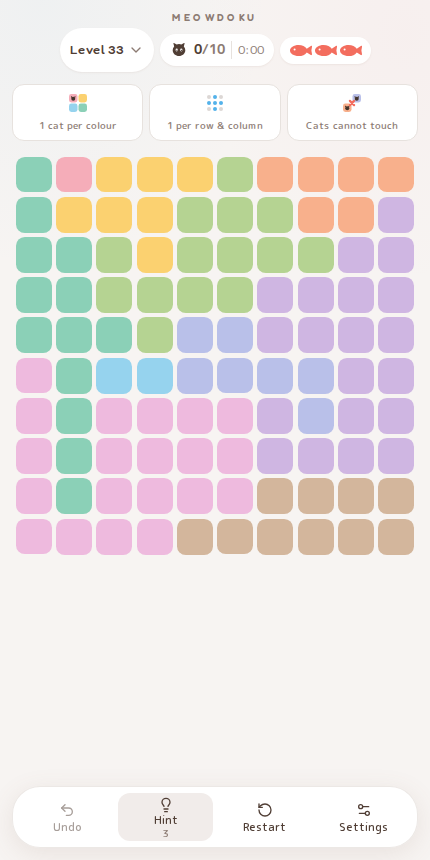
Meowdoku Level 33 at a glance
- Board: 10×10 grid with 10 colored regions and 10 cats to place
- Difficulty: Easy
- Hardest technique needed: Color locked to one line
- Logical steps: 13 (10 cats and 3 crosses)
- Smallest color: rose with 1 tile
The Meowdoku Level 33 board at a glance
The ten colors on this board are rose, apricot, butter, matcha, mint, soda, periwinkle, lilac, bubblegum, and latte. Rose is the smallest with one tile at row 1, column 2, and soda is next with just two tiles side by side at row 6, columns 3 and 4. Apricot has six tiles along the top right, while butter and periwinkle each have seven.
Latte has ten tiles in the bottom right corner, mint has thirteen running down the left side, and matcha has fourteen across the middle. The two giants are lilac and bubblegum, each with twenty tiles, lilac on the right and bubblegum in the bottom left.
That mix of two very small regions and two very large ones is what keeps this cat puzzle game gentle. The tiny colors give you free cats early, and the huge colors simply wait their turn at the end.
The opening move: rose has only one home
Start Meowdoku Level 33 with the rose cat on row 1, column 2. Rose is a one-tile region, so the cat is forced there before you have looked at anything else. Double-tap the tile and the first of ten cats is settled.
That single cat clears row 1, column 2, and the tiles touching it, which is enough to start squeezing butter in the rows just below. On a board this wide the first cat rarely does much on its own, but here it sets up the one deduction that matters.
If you like, you can also glance at soda now. Its two tiles sit at row 6, columns 3 and 4, and they touch each other, so whichever one takes the cat, the other is excluded. Soda will resolve as the third cat once mint and butter have moved out of the way.
The key moment: apricot is locked to row 2
The only genuine piece of reasoning in Meowdoku Level 33 is about apricot, and it pays off twice. After the rose cat is placed, every open apricot tile sits in row 2. Since apricot has to place a cat somewhere, the cat in row 2 must be the apricot one. That is technique T3, a color locked to one line, and it means no other color may use row 2.
Apply that immediately. Cross out the butter tile at row 2, column 4, and butter instantly drops to a single open tile, so the second cat goes on row 3, column 4. Soda follows on row 6, column 3 as the last open tile in its color.
Then use the same fact again for matcha. Because row 2 belongs to apricot, the matcha tiles at row 2, column 6 and row 2, column 7 both get crossed out, leaving matcha with one open tile at row 4, column 6. That is all the thinking the board asks for. Mint lands on row 5, column 1, periwinkle on row 7, column 8, apricot on row 2, column 9, lilac on row 8, column 10, bubblegum on row 9, column 5, and latte on row 10, column 7, each as the last open tile in its region.
Habits worth keeping for harder boards
It is tempting to rush a level like this, but Meowdoku Level 33 is actually a nice place to practise good technique, because the answers come quickly enough to confirm that your reasoning was right. The same moves show up on hard boards where mistakes are expensive.
A few things are worth doing deliberately here so they become automatic later in these free online games.
- Count the region sizes before your first move so you know which colors will resolve early.
- Place every one-tile color immediately, then look for two-tile colors like soda.
- When a color fits inside a single row, reuse that fact on every color that passes through the row, not just the first one.
- Re-examine the small and medium regions after each cat; on a 10x10 board the giants are never the ones that shrink first.
- Trust the logic instead of your eyes. A cat that merely looks right can still cost you a fish.
Why Meowdoku is a great cat puzzle game
Meowdoku takes a clean logic idea and wraps it in something cozy. Every board is guaranteed solvable by reasoning alone, hints exist for when you stall, and nothing punishes you for taking your time. That combination puts it among the friendliest brain games you can open in a browser tab.
It also scales nicely. A 10x10 board like Level 33 can be an easy ten-minute stroll or, at a higher difficulty band, a real test, and the cats keep both extremes charming. If you enjoy sudoku-style puzzles but want something warmer, these cat games are an easy recommendation.
Step-by-step Meowdoku Level 33 solution
Every cat below is forced by logic, in the order a careful solver finds them. No guessing is needed. If you only want a nudge, read one step, close this page, and return to the game.
Cat 1: row 1, column 2 (rose)
The rose region has only one open tile left, so its cat goes on row 1, column 2. Technique: Last open tile in a color.

Cat 2: row 3, column 4 (butter)
First, cross out the tiles that cannot hold a cat:
- Every open apricot tile sits in row 2, so that row's cat must be apricot. Cross out the butter tile at row 2, column 4.
With the rows, columns, and neighbors of the first cat crossed out, the butter region has only one open tile left, so its cat goes on row 3, column 4. Technique: Last open tile in a color.
Cat 3: row 6, column 3 (soda)
With the rows, columns, and neighbors of the 2 cats placed so far crossed out, the soda region has only one open tile left, so its cat goes on row 6, column 3. Technique: Last open tile in a color.
Cat 4: row 4, column 6 (matcha)
First, cross out the tiles that cannot hold a cat:
- Every open apricot tile sits in row 2, so that row's cat must be apricot. Cross out the matcha tile at row 2, column 6.
- Every open apricot tile sits in row 2, so that row's cat must be apricot. Cross out the matcha tile at row 2, column 7.
With the rows, columns, and neighbors of the 3 cats placed so far crossed out, the matcha region has only one open tile left, so its cat goes on row 4, column 6. Technique: Last open tile in a color.
Cat 5: row 5, column 1 (mint)
With the rows, columns, and neighbors of the 4 cats placed so far crossed out, the mint region has only one open tile left, so its cat goes on row 5, column 1. Technique: Last open tile in a color.
Cat 6: row 7, column 8 (periwinkle)
With the rows, columns, and neighbors of the 5 cats placed so far crossed out, the periwinkle region has only one open tile left, so its cat goes on row 7, column 8. Technique: Last open tile in a color.
Cat 7: row 2, column 9 (apricot)
With the rows, columns, and neighbors of the 6 cats placed so far crossed out, the apricot region has only one open tile left, so its cat goes on row 2, column 9. Technique: Last open tile in a color.
Cat 8: row 8, column 10 (lilac)
With the rows, columns, and neighbors of the 7 cats placed so far crossed out, the lilac region has only one open tile left, so its cat goes on row 8, column 10. Technique: Last open tile in a color.
Cat 9: row 9, column 5 (bubblegum)
With the rows, columns, and neighbors of the 8 cats placed so far crossed out, the bubblegum region has only one open tile left, so its cat goes on row 9, column 5. Technique: Last open tile in a color.
Cat 10: row 10, column 7 (latte)
With the rows, columns, and neighbors of the 9 cats placed so far crossed out, the latte region has only one open tile left, so its cat goes on row 10, column 7. Technique: Last open tile in a color.
Meowdoku Level 33 solved board
Here is the finished board. Every row, every column, and every color holds exactly one cat, and no two cats touch, not even at the corners.
Meowdoku Level 33 FAQ
What is the solution to Meowdoku Level 33?
In solve order, the cats go on row 1, column 2 (rose); row 3, column 4 (butter); row 6, column 3 (soda); row 4, column 6 (matcha); row 5, column 1 (mint); row 7, column 8 (periwinkle); row 2, column 9 (apricot); row 8, column 10 (lilac); row 9, column 5 (bubblegum); and row 10, column 7 (latte).
What is the first move in Meowdoku Level 33?
Place the first cat on row 1, column 2. Rose is a single-tile region on this board, so that is the only tile its cat can take and it is always a safe opening in these cat games.
How does apricot help solve Meowdoku Level 33?
Every open apricot tile sits in row 2, so row 2 is reserved for the apricot cat. That lets you cross the butter tile at row 2, column 4, which forces butter onto row 3, column 4, and later cross the matcha tiles at row 2, column 6 and row 2, column 7, which forces matcha onto row 4, column 6.
Is Meowdoku Level 33 easy despite being a 10x10 board?
Yes. It is rated easy because the solve is only 13 steps with 3 crosses, and the hardest idea used is a color locked to a single line. Size alone does not make these animal games hard.
How do the controls work in Meowdoku?
Single-tap a tile to toggle a cross and double-tap to settle a cat. A wrong cat costs one fish, and a hint shows the next forced cat, which keeps these free online games fair even on the biggest boards.
- Meowdoku
- Meowdoku Level 33
- Meowdoku walkthrough
- Meowdoku Level 33 solution
- cat games
- animal games
- cat puzzle game
- animal puzzle games
- logic puzzle games
- brain games
- free online games
- browser games
- sudoku-style puzzles
- cozy games